 Loading... Please wait...
- Home
- Books & Media
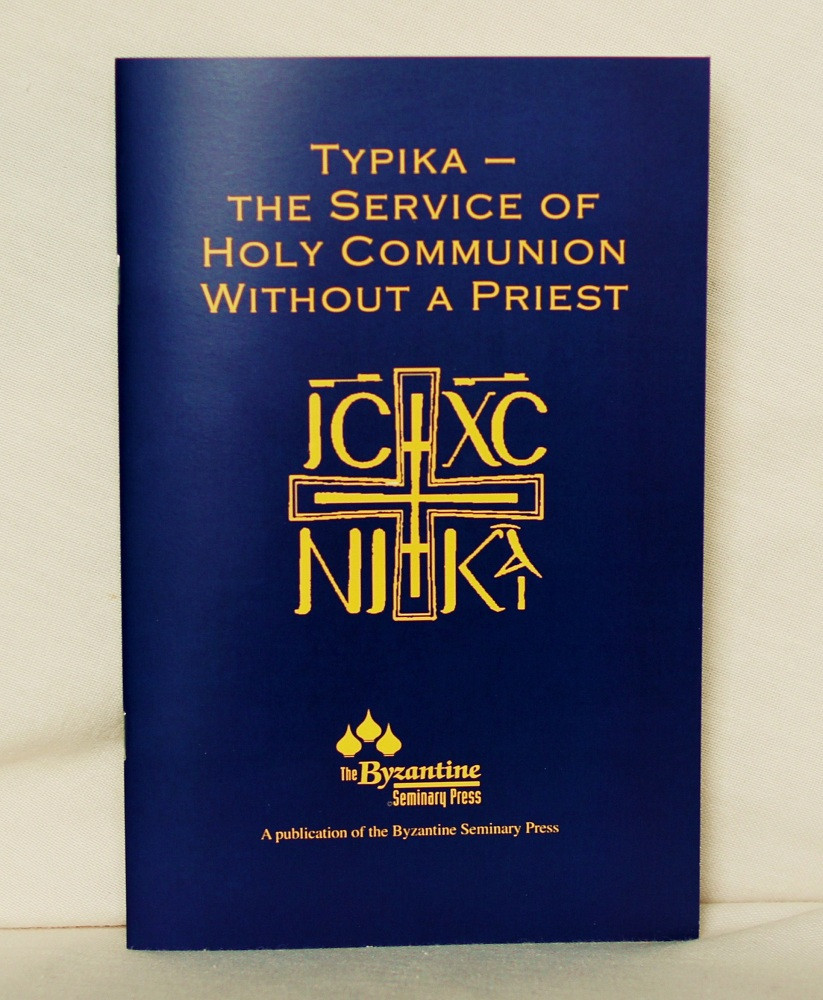
- Typika - The Service of Holy Communion Without A Priest (Pew version)
- Home
- Books & Media
- Liturgical Books
- Typika - The Service of Holy Communion Without A Priest (Pew version)


, $6.00 (https://www.byzantineseminarypress.com/typika-the-service-of-holy-communion-without-a-priest-pew-version/))
Typika - The Service of Holy Communion Without A Priest (Pew version)

Product Description
Paperback, 44 pages
Pew version
This edition of Typika has been prepared for the use of deacons and faithful in the Byzantine Ruthenian Metropolitan Church of Pittsburgh by the Intereparchial Commission for Sacred Liturgy. While Typika without holy communion has a regular place in the daily "hours" of the Divine Praises, it is to be noted that this service with holy communion and served only by a deacon is exceptional and for those emergency situations when a priest is not available to celebrate the Divine Liturgy. The deacon who is to conduct this service must have the permission of the local ordinary.
Find Similar Products by Category
Product Reviews

-
Better than expected
Posted by Adam Kemner on 16th Sep 2014
This edition was better than anticipated. The service is complete, following the pattern more like we see in the Melkite Horologion. The main difference between this edition and other editions (mostly Orthodox) is that parts of the Enarxis from the Small Entrance to the readings are omitted-the Entrance verse, and the Trisagion, namely. These are customs of the Russian Old Rite that often get imported to Typika-as-communion-service, but are not a part of the Horologion. Plus features are that the Typikal Psalms are included in full, as well as the Beatitudes, and the verses from the Octoechos for each Sunday in each tone are included, as well as a set of Tone 6 verses for weekdays (I am unsure which ones they are). Also Psalm 33 in included as the Communion Psalm.
The translation is in line with the 2006 translation of the Divine Liturgy. The major drawback is that there isn't a music book to go along with it. Some thought would need to be given if all the verses the psalms should be set to the two sets of melodies. Prostopinije has a set of melodies in each tone for the verses and troparia of the Beatitudes from the Choma Prostopinije, so these can be used. "Choirs of Angels" (before the Creed) is in Tone 6, and this rubric is missing.
All in all, the service is complete, and the rubrics for the Deacon are ample and clear. When celebrating this service (our outreach has used it twice), the Kontakion takes us by surprise, so maybe a title heading at this point could have been added or made clearer. This service can easily be used in a non-Eucharistic context (i.e. the Horologion) by simply disregarding the rubics and the communion hymn, and the first part can be used in the Divine Liturgy very easily if a community wished for a fuller use of the Typikal Psalms and Beatitudes for the Divine Liturgy.